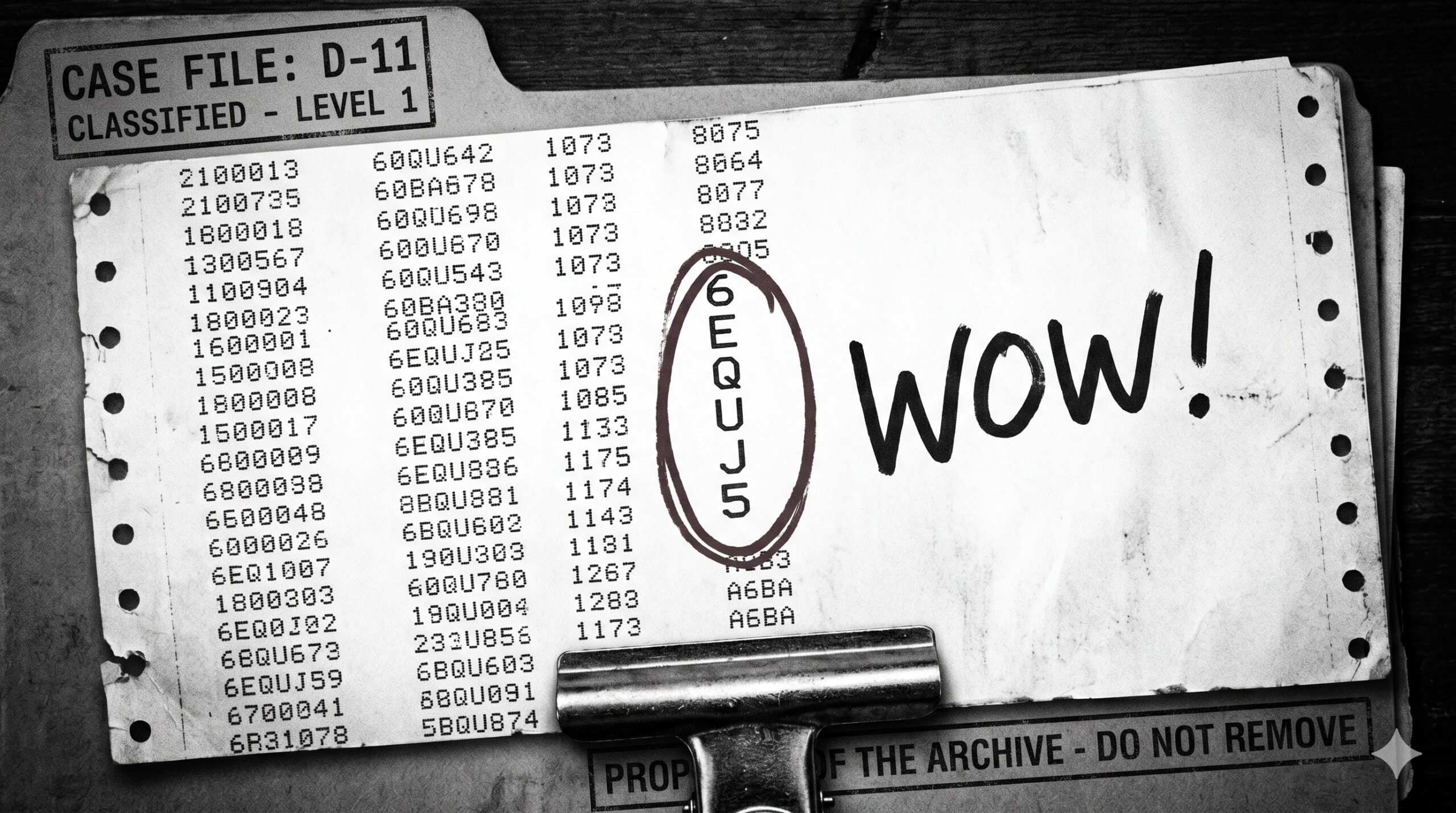
CASE FILE: #D-11
DESIGNATION: The Sagittarius Anomaly
CATEGORY: Sky & Space / Deep Space
FOCUS METRIC: Wow Signal 2026
STATUS: Public
DATA REVISION: April 2026
EXECUTIVE SUMMARY
On August 15, 1977, the Big Ear radio telescope at Ohio State University detected a powerful 72-second narrowband signal. The anomaly matched the 1420 MHz hydrogen line—the universal “radio dial tone” logically expected for interstellar communication. The transmission was so intense that astronomer Jerry Ehman circled the alphanumeric sequence “6EQUJ5” on the computer printout and wrote “Wow!” in the margin. For nearly 50 years, this stood as the gold standard for potential extraterrestrial contact. However, the Wow Signal 2026 data re-evaluation has opened a new forensic chapter. Researchers are realizing we may have been looking for the right anomaly, but in the wrong spatial weather.
Wow Signal 2026: Critical Metrics and Reanalysis
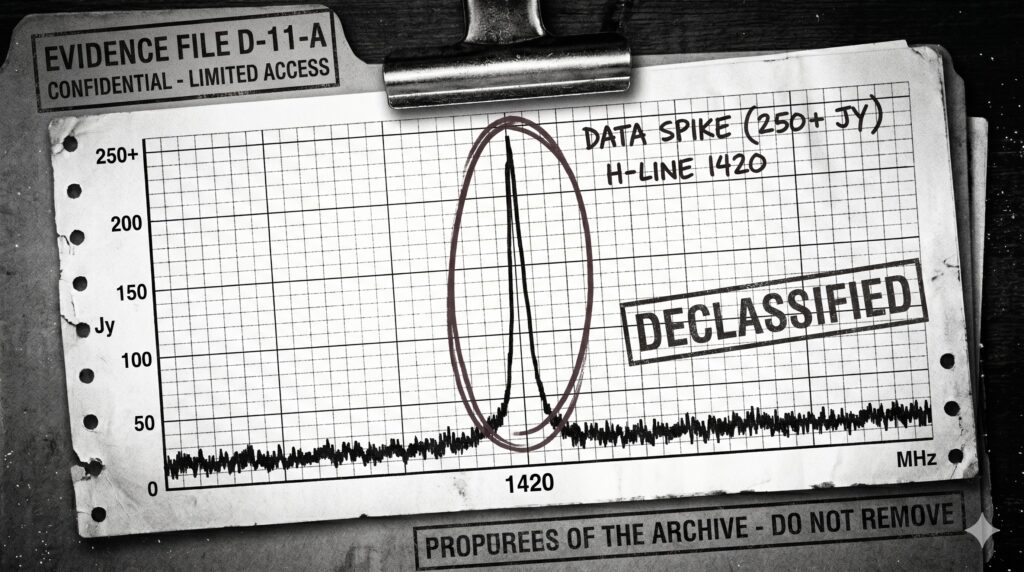
Despite decades of targeted follow-up toward the Sagittarius constellation, the signal never repeated. However, the archival reanalysis driving the Wow Signal 2026 intelligence review has fundamentally shifted our understanding of the event’s parameters:
- The 250-Jansky Reality: Archival algorithms demonstrate the signal was up to four times stronger than originally estimated, peaking over 250 Janskys.
- Refined Coordinates: The origin point has been restricted with high confidence to two adjacent fields (RA 19h25m02s or 19h27m55s).
- Artificial Mimicry: The re-evaluation confirmed the signal was not terrestrial interference; it was a high-radial-velocity galactic source that perfectly mimicked an artificial transmission.
ENVIRONMENTAL VARIABLES: EXO-IPM SCATTERING
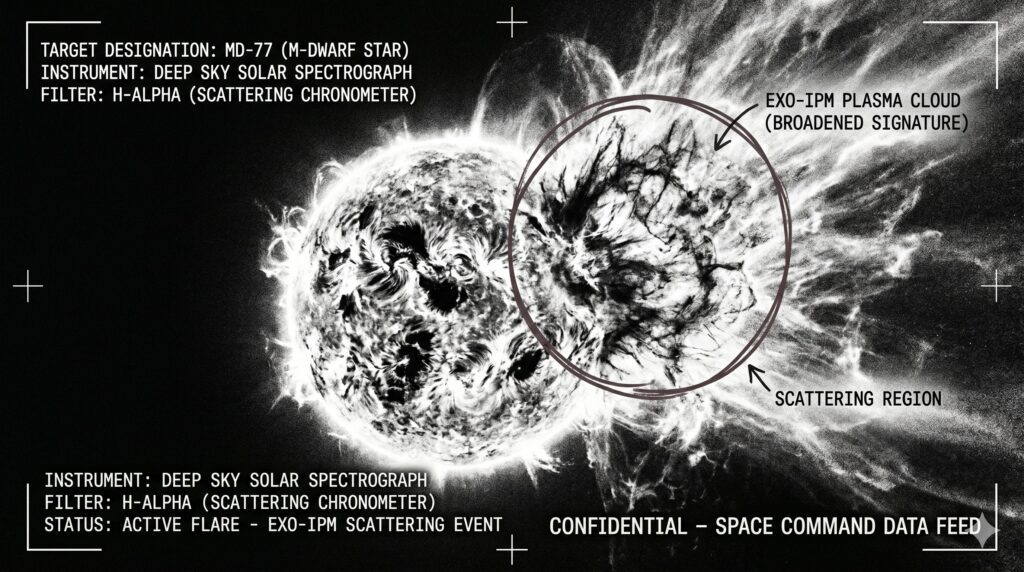
To understand the silence following the 1977 event, we must analyze the most common stars in the galaxy. Red dwarfs (M-dwarfs) are small, cool, and host the majority of the Milky Way’s rocky planets. Comprising 75% of the stellar population, they are prime targets for habitable zones. They are also magnetically hyperactive, generating dense stellar winds full of turbulent plasma.
A breakthrough SETI Institute study cited in the Wow Signal 2026 framework introduces the concept of Exo-IPM (Interplanetary Medium) Scattering. Their metrology proves that the dense, turbulent plasma surrounding M-dwarfs acts as a “radio fog.”
If an advanced civilization broadcasts a perfect, narrowband technosignature, their star’s space weather scatters it into a wider, fainter blur before it ever leaves the system. Traditional SETI pipelines, strictly tuned for razor-sharp narrowband signals, actively miss these broadened anomalies.
THE LAB: FORENSIC MISE EN PLACE
In the Lab, we approach an anomaly with the same mise en place utilized in a professional kitchen: every environmental variable must be accounted for before you can analyze the final result.
Comparing the Wow! Signal to the noise of a commercial kitchen is the perfect operational analogy. You may be listening for the precise, high-frequency chime of a specific oven timer. However, if the environment is clattering and heavy ventilation fans are whirring (the “Stellar Fog”), the pure frequency of that timer gets distorted, scattered, and lost in the environmental acoustics.
The 2026 telemetry indicates we have not been failing to hear anomalies; we have been failing to account for the acoustic distortion of their native solar systems.
ADDENDUM: RESOLVED QUERIES
- Signal Repetition: The original anomaly remains a one-time “transient” event. The lack of repeated narrowband hits does not equal absence; it suggests a requirement for broadened detection tools.
- Plasma Obfuscation: Metrology confirms plasma turbulence actively smears frequencies, pushing them below the detection thresholds of classic narrowband pipelines.
The ultimate conclusion of the Wow Signal 2026 analysis is that the next anomaly may not be one loud blast. It is highly probable that it exists as thousands of slightly smeared signals currently hiding in plain sight within our archival data, waiting for the correct algorithms to decode the fog.
END OF FILE. To receive encrypted transmission updates when new Case Files and unredacted raw data are declassified, Subscribe Here.