[EXECUTIVE BRIEFING]
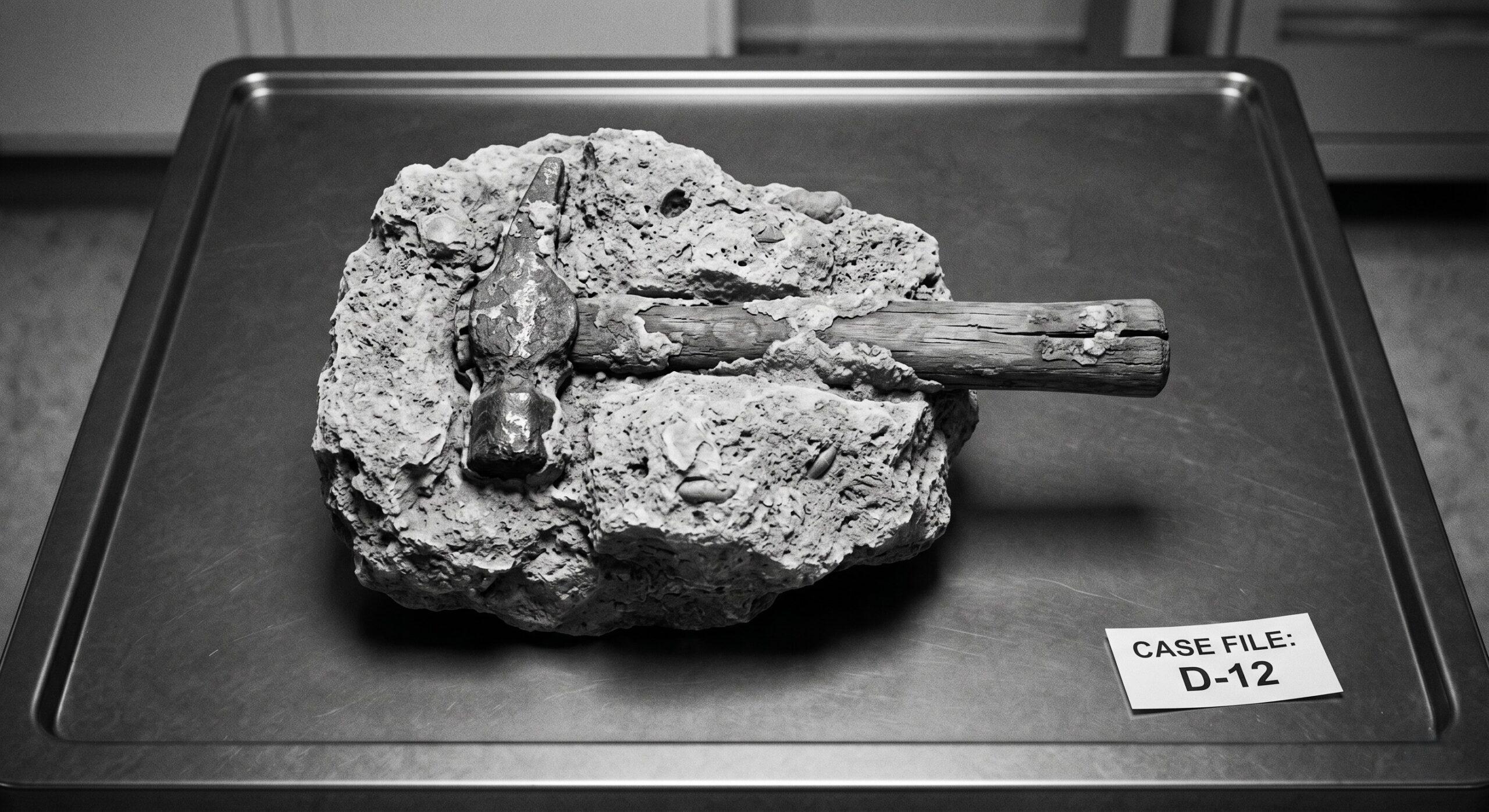
This London Hammer 2026 forensic reassessment examines the 19th-century iron tool recovered near London, Texas in 1936, which was found partially encased in a limestone concretion. The object surfaced loose in a creek bed along Red Creek. This forensic review isolates the metallurgical and geological data to separate observed physical properties from creationist and ancient-alien interpretive claims.
Key Forensic Takeaways:
- Metallurgy: The hammer head composition is 96.6% iron, 2.6% chlorine, and 0.74% sulfur.
- Geology: The concretion derives from soluble limestone in the Hensell Sand Formation (Lower Cretaceous, ~115 million years old).
- Mechanism: Rapid concretion formation around modern objects is a documented geological process requiring decades, not millennia.
- Stratigraphy: Zero evidence places the hammer in situ within undisturbed Cretaceous bedrock.
London Hammer 2026: The Geological Context
The find location is situated near London in Kimble County, Texas, along Red Creek in the Edwards Plateau region. The surrounding rock formations belong to the Hensell Sand Member of the Travis Formation. This specific geological layer is definitively dated to the Lower Cretaceous period.
While claims of Ordovician rock circulate in fringe literature, this London Hammer 2026 analysis firmly links the nodule to local Cretaceous limestone-derived material. However, modern field assessments firmly link the nodule to local Cretaceous limestone-derived material. The hammer was never documented in undisturbed bedrock; it was recovered loose in an active water-way.
METALLURGICAL ASSAY: THE BATTELLE DATA
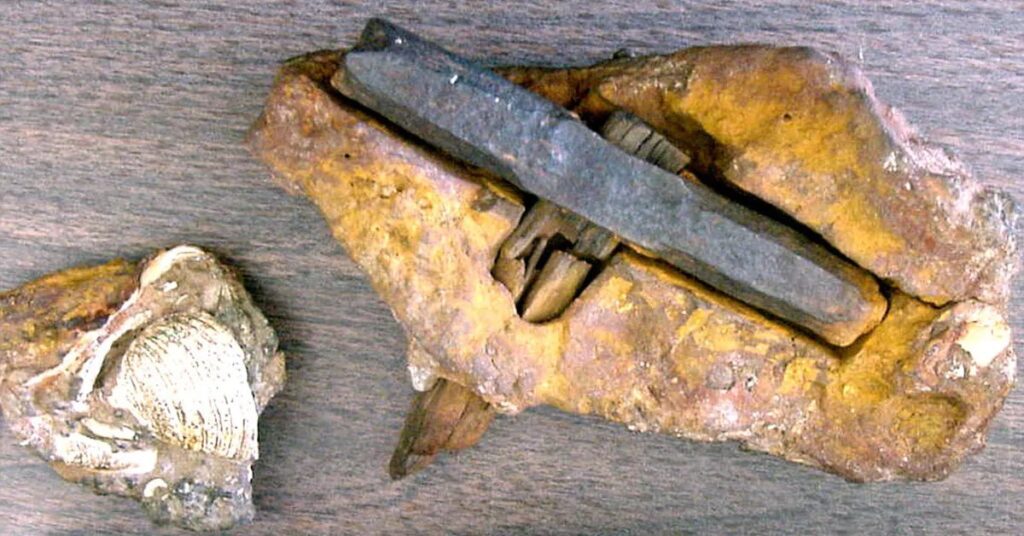
An 1989 analysis allegedly conducted at the Battelle Memorial Institute reported the hammer head as highly pure. The data indicates 96.6% iron, 2.6% chlorine, and 0.74% sulfur. This metal shows low carbon content, resulting in minimal rusting on the exposed surfaces.
High chlorine levels are unusual for typical 19th-century wrought iron. However, this anomaly can result from sustained environmental exposure or mineral interaction during the concretion process. It must be noted that no formal, peer-reviewed Battelle report was ever publicly released; all available data originates from secondary custodial accounts.
THE LIMESTONE CONCRETION PARADOX
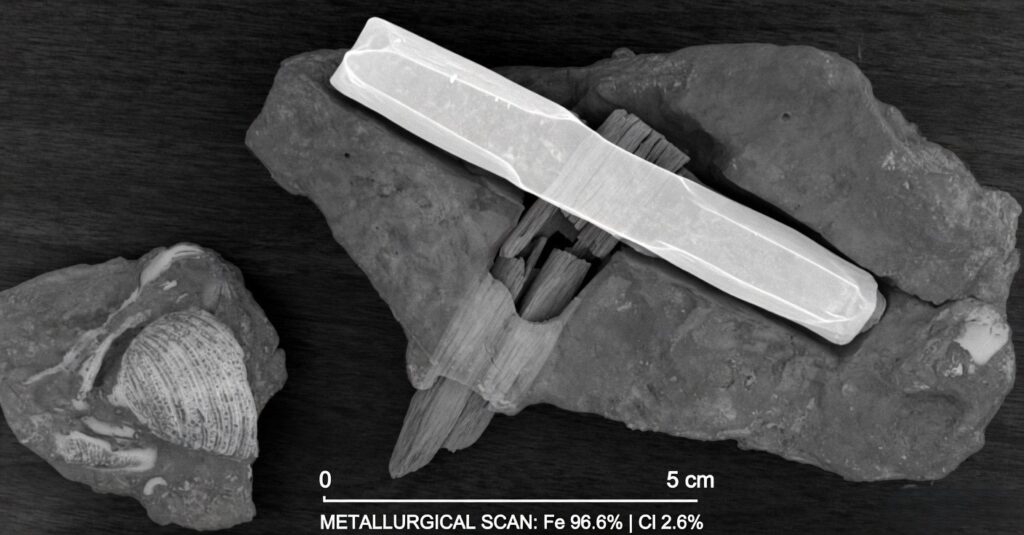
Concretions form when dissolved minerals precipitate around a nucleus in groundwater-rich environments. The highly soluble limestone in the Texas region allows for incredibly rapid cementation. Similar nodules have routinely formed around modern objects, including 20th-century spark plugs and watches, within a matter of decades.
This petrifaction process does not require millions of years. Mineral-laden water percolating through creek deposits can encase dropped tools quickly when conditions align with high carbonate saturation. Link to external resource: U.S. Geological Survey (USGS) data on concretion formation.
LONDON HAMMER 2026: THE FINAL VERDICT
The ultimate verdict of this London Hammer 2026 investigation is that the object is a genuine 19th-century miner’s tool that underwent accelerated concretion in a limestone-rich setting. It displays absolutely no evidence of advanced ancient metallurgy or pre-Cretaceous origin.
Data misinterpretation frequently occurs without the proper environmental context. This mirrors our recent findings where initial telemetry required later stellar plasma modeling for an accurate assessment. Internal Link: Read Case File D-11: Wow Signal 2026 Reassessment.
The object illustrates how natural geological processes can produce striking associations between recent artifacts and older rock matrices. No extraordinary claims are required to explain the physical evidence.
This London Hammer 2026 dossier is part of our ongoing investigation into Texas-based geological anomalies.
DOSSIER FAQ
What is the exact metallurgical composition of the London Hammer head? Secondary data from the 1989 Battelle test indicates 96.6% iron, 2.6% chlorine, and 0.74% sulfur.
Is the surrounding rock truly 100+ million years old? The minerals forming the concretion derived from Cretaceous formations, but the concretion itself formed recently around the hammer. It is not undisturbed ancient bedrock.
Why has the hammer shown limited corrosion? High-purity iron, combined with surface chlorine content and the protective airtight concretion, significantly reduces oxidation rates.
Has carbon-14 dating been performed on the wooden handle? Limited private testing has been reported, but no comprehensive, peer-reviewed radiocarbon results have been released by the current custodians.
What is the current scientific consensus on the London Hammer? It is strictly classified as a 19th-century tool encased by rapid geological concretion, completely consistent with known mineralization processes.